

In the game of Tic-Tac-Toe (Noughts and Crosses in some countries), one works with a 3 x 3, filling out the cells. Here is a game to fill out 3 x 3 cells but the task involves the relationship between the trailing price-earnings ratio (P/E) and the price-to-book ratio (P/B). Here is the layout:
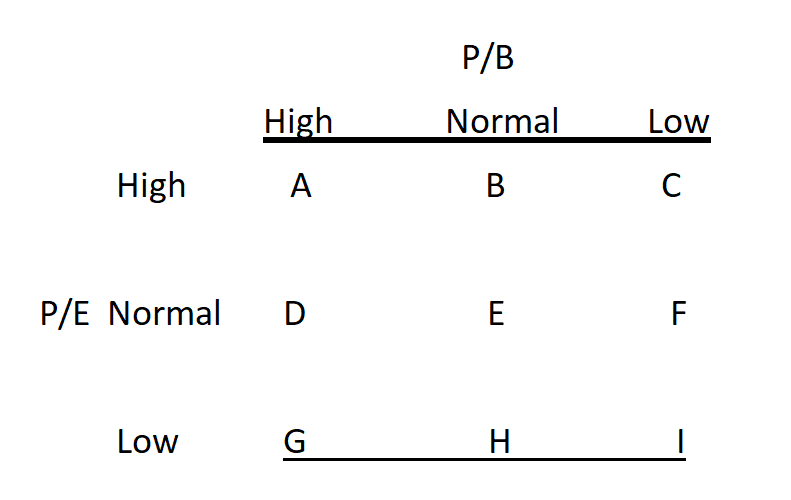
The 3 x 3 is a combination of P/E and P/B, each broken up into three levels, high, normal, and low. A normal P/E is one with no growth, that is, P/E = which is equal to 10 if the required return is 10%. A normal P/E is also one with no growth in residual earnings. So high P/E above normal (for example) is one where residual earnings are expected to grow. A normal P/B = 1.0, that is, a P/B where expected future residual earnings are zero. So a high P/B (for example) is one with positive expected future residual earnings.
So, fill out the cells!
Here is the solution. (Don’t look before you have played the game!)
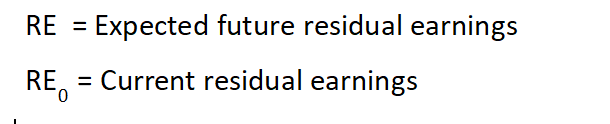
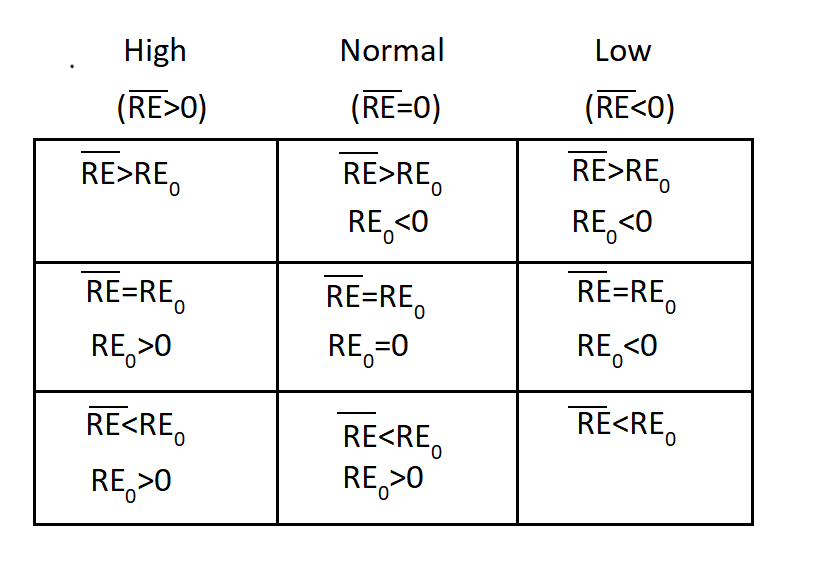
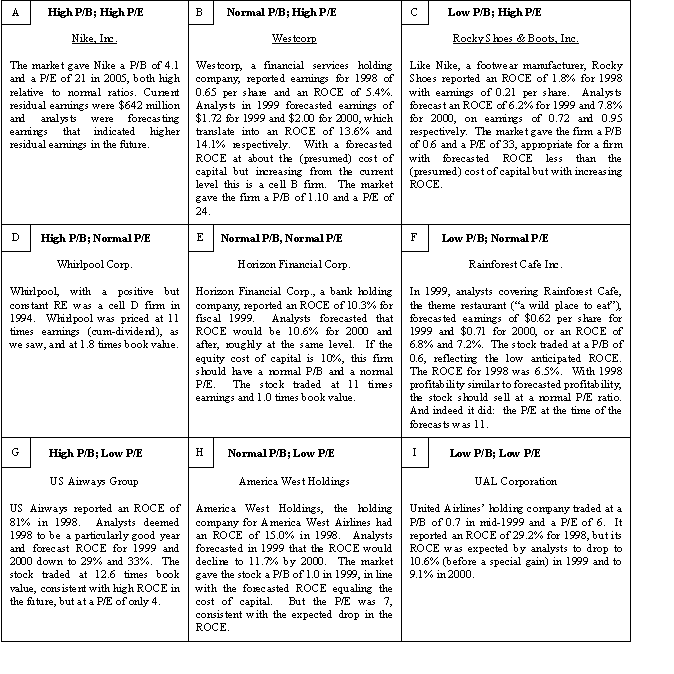
We played this game some time ago. Here are companies slotted into the respective cells by comparing the expected future RE to the current RE:
What do we learn from this?
-
- P/E indicates growth in RE but this could be from a very low base: Firms in cell C with low P/B can be high P/E firms
- Trailing P/E reflects growth and transitory earnings. If earnings are temporarily low, P/E will be high
- The Molodovsky Effect:
- Cells B and H are pure Molodovsky effects: current earnings include one-time unsustainable transitory income which cannot grow. So a high P/E could be due to a one-time impairment charge thst reduces earnings, for example.
- Cells A, C, G and I are mixed growth and Molodovsky effects