

The fundamentals underlying the forward P/E were demonstrated in chapter 2 with a simple valuation model:
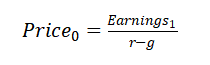
and thus

But, while helpful in demonstrating the point, the model is a bit too simple. It only works for positive earnings, and it assumes full payout of earnings with dividends. However, the P/E can be expressed with the favored valuation model of chapter 3, the residual earning model where growth is valued only when earnings cover the required return.
To see this, think of the residual earnings model with no growth:
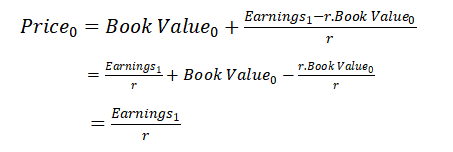
and the forward P/E ratio =  This is the P/E with no growth in the simple valuation model.
So, a P/E with no growth is just given by r, the required return. If r = 10%, P/E = 10 and E/P = 10%.
A P/E higher than this is one with growth and that is given by

Note, again, that g here is not growth in earnings but rather growth in residual earnings; it is residual earnings growth that is valued, not earnings growth. Note also a theme in chapter 2 and throughout the book: Buying growth is risky, so buying more g can mean higher risk and thus a higher r, as with the analysis of the P/E in chapter 2.
This discussion points to two mistakes an investor can make in evaluating P/E ratios.
First, the investor might evaluate a P/E ratio based on expected earnings growth rather than value-added earnings growth, residual earnings. Setting a high P/E based on earnings growth from M&A is a good example: The acquisition may add considerable earnings growth but not necessarily value-added earnings that covers the cost of capital.
Second, the investor might not appreciate that growth does not necessarily add to price. If residual earnings growth is at risk of not being realized, it adds to r and thus should be discounted in the price. A risky acquisition might add to residual earnings growth but might not add to price because the expected growth is fully discounted for the risk.