

Below is a picture that gives the structure of the accounting book that tracks accounting for value. You can see that the structure consists of financial statements, tied together by a set of accounting equations.
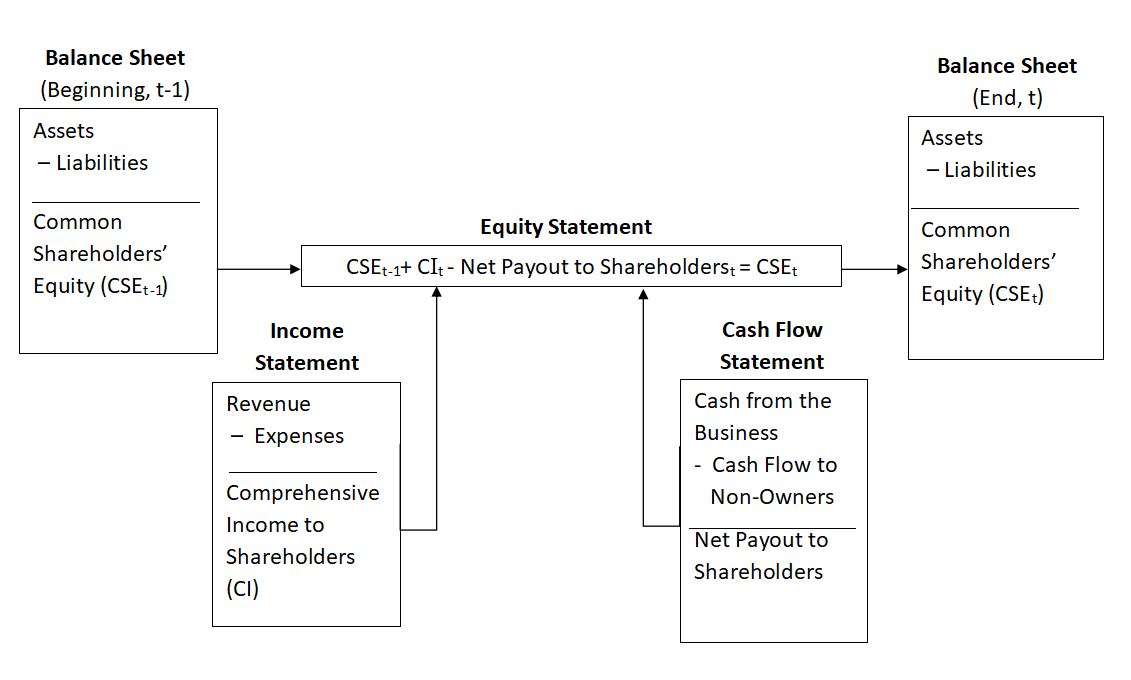
There are four financial statements produced by the accounting: A balance sheet at the beginning and end of a period, the income statement, the cash flow statement, and the statement of changes in common shareholders’ equity (CSE). The shareholders’ equity statement is often not mentioned but you can see in the diagram it lies at the center of things for it explains the change in shareholders’ equity from the beginning balance sheet to the ending balance sheet. The change in shareholders’ equity is explained by
CSEt-1+ CIt – Net Payout to Shareholderst = CSEt
That is, equity in increased by adding all income, comprehensive income (CI), and reduced by Net Payout to Shareholders which is Dividends + Share Repurchases – Share Issues. This equation is known as the Clean Surplus Equation, clean surplus because all sources of income, comprehensive income, must be included. (GAAP and IFRS typically have two statements for income, the Income Statement and the Other Comprehensive Income Statement totaling to Comprehensive Income, CI).
The diagram then displays the (comprehensive) income statement as giving more detail on how the income was generated:
Revenuet ‒ Expensest
The cash flow statement explains the net payments to shareholders as the remainder from free cash flow generated by the business after paying off the other claimants, usually net debt holders:
Net Payout to Shareholderst = Free Cash Flowt – Cash to Other Non-equity investors
The balance sheet reports the resulting shareholders’ equity but explains it with assets and liabilities:
CSEt = Assetst – Liabilitiest
That, of course, is the balance sheet equation.
Note that GAAP and IFRS do not present some of these statements in the same format, something we will have to iron out as we proceed.
Behind all of this, double-entry accounting is working. By increasing shareholders’ equity with income, assets and liabilities must also be affected (double entry) otherwise the balance sheet equation will not hold. An example: In recording revenue (a credit in accounting parlance), an asset, cash or accounts receivable must also be recorded (a debit). These effects of double entry are important when taking accounting to valuation, as later chapters show.